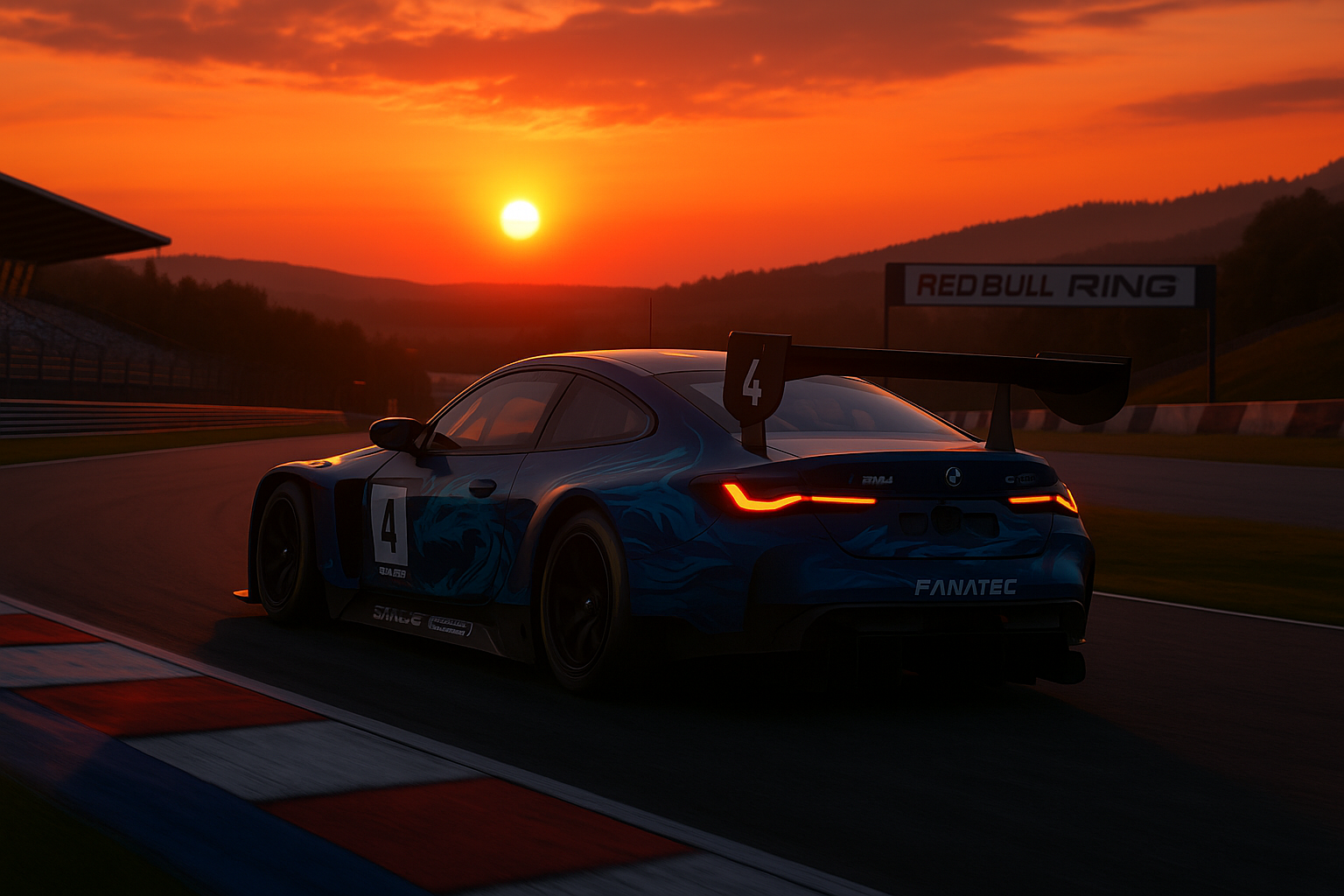
There are races where you fight the car.
And then there are races where everything clicks.
This was one of those.
Red Bull Ring — 32 cars on the grid, P27 start.
The goal was simple: stay calm, stay clean, and let the rhythm build.
From the first laps, the BMW M4 GT3 felt perfectly balanced — sharp on entry, stable on throttle, and absolutely planted through the fast sections.
Tyre pressures stayed consistently in the sweet spot between 27.1–27.5 psi, and for the entire hour there wasn’t a single moment where the setup felt off.
It was pure flow — calm focus, controlled aggression.
Only when letting faster traffic by, did I have to step off the racing line into the dirty part of the track. Quick instinct — TC4 → TC5, and grip was instantly back.
After that, everything returned to rhythm.
Average lap: 1:31.0
Best lap: 1:30.6
Qualifying: 1:30.026 — compared to the session’s best 1:27.6.
Three seconds to the absolute top, but just one second away from the Bronze winner’s pace.
P22 overall. P3 in Bronze. Out of 32.
It wasn’t chaos. It was precision.
A race where the car, the driver, and the moment aligned.
⚙️ Fuel Strategy — Precision in the Details
In the previous race, fuel planning had been chaos. This time, it was control.
Practice and qualifying both showed an average fuel consumption of 2.61 L per lap, but I knew that in BMW M4 GT3, race usage tends to climb.
I applied a 6 % correction factor, calculating for 2.77 L per lap — and it worked almost perfectly.
When entering the pits, there were 2 L left, and at the finish, 3 L remained — a comfortable margin that still kept the car light.
For the next round, a 7 % buffer feels ideal, leaving room for one extra lap if strategy ever calls for it.
Last time, fuel was guesswork.
This time, it was mathematics.
⏱️ Pit Stop — Finding the Right Rhythm
Before the stop, I was running about 4 seconds behind Frackus. After the pit, the gap grew to 6 seconds — meaning I lost roughly 2 seconds during the pit phase compared to the Bronze leaders.
I took the entry calmly.
Braked to ~50 km/h about 100 m before the pit entry line — covering roughly 30 m at reduced speed. Next time, the ideal braking point looks closer to 80 m.
Inside the lane, I stayed cautious around stationary cars — clean, no penalties, but a bit too careful. Still, overall, it was a solid, safe stop.
The kind you can build on.
🧭 Track Limits — The Art of the Edge
One of the biggest lessons this time wasn’t about speed — it was about space.
In Gran Turismo 7, track limits are sacred: touch the curb wrong and you are penalised.
But in ACC, the fast drivers treat the edges like living, moving boundaries — something to use, not fear.
Being lapped by the top 17 gave me a front-row view of how the best drivers play with the limits — pushing curbs wide, clipping apexes aggressively, turning every inch of asphalt into opportunity.
But I also saw the risk: several moments where the line was crossed, and the car snapped away.
The difference isn’t courage — it’s awareness.
True pace comes not from ignoring the limits, but from dancing right on top of them.
🧠 Driving Style — Control Over Chaos
For the first time, I truly felt like I was racing ACC, not surviving it.
The car’s balance gave me freedom — freedom to look around, to think strategically, and to see the race unfold instead of just reacting to it.
In the final 10 laps, Frackus held a 6-second lead ahead. Slowly, the gap grew by about 0.5 s per lap — my tyres had climbed to 27.4 psi, and I knew there was no more grip to push harder without risking the car.
Then, with five laps to go, it happened.
Frackus spun.
From 9 seconds ahead to behind. Likely the same pressure curve — a fraction too high, the tyre ballooning, losing contact with the asphalt.
That’s how I gained one more position, finishing P22 overall, and locking in P3 in Bronze.
Not luck — just patience.
A race not decided by aggression, but by composure.
🔧 Next Focus — The Path to Bronze Lead
Every race teaches something new — this one showed that the foundation is finally solid.
The setup, pit work, and fuel management are now consistent.
The next second won’t come from changing the car — it will come from refining the driver.
Key area to improve:
➡️ Corner entry and brake release.
Right now, I carry good speed into the corners, but the transition between braking and turning still leaves a fraction of grip unused. The goal is to release the brake earlier and smoother, allowing the front tyres to load naturally and the car to rotate with less steering input.
How to train it:
- Practice 5–10 lap stints focusing only on brake modulation — lift pressure gradually instead of holding until apex.
- Rewatch telemetry traces of top Bronze drivers to compare brake release curve and minimum corner speed.
- Use consistent reference points (braking cones, track shadows) to build muscle memory lap after lap.
At this level, it’s easy to think others are “aliens.”
But they’re not. They’re just drivers who’ve already unlearned the habits that still hold me back.
GT7 built great discipline — a sense of structure and repetition. I still love that about it. The license tests there are brilliant: you can practice a single corner a hundred times until it becomes instinct.
ACC doesn’t have that luxury, so I’ll build my own version of it.
From now on, it’s back to fundamentals — learning, testing, and observing.
Over the next week, I’ll start mapping out what habits I still carry from GT7, which ones must change, and how to rebuild my driving from the ground up.
Because we’re all human.
And humans can learn anything. 🐉
BlueDragonRacing #Sceleton1_0 #SimRacing #AssettoCorsaCompetizione #BMWM4GT3 #RedBullRing #SimRacingEstonia #SimRacerLife #RoadToRedBull #ACCChronicles #PrecisionRacing #RaceAnalysis #PitStopStrategy #TyrePressure #Fanatec #RacingMindset #LearnToFly
Leave a Reply