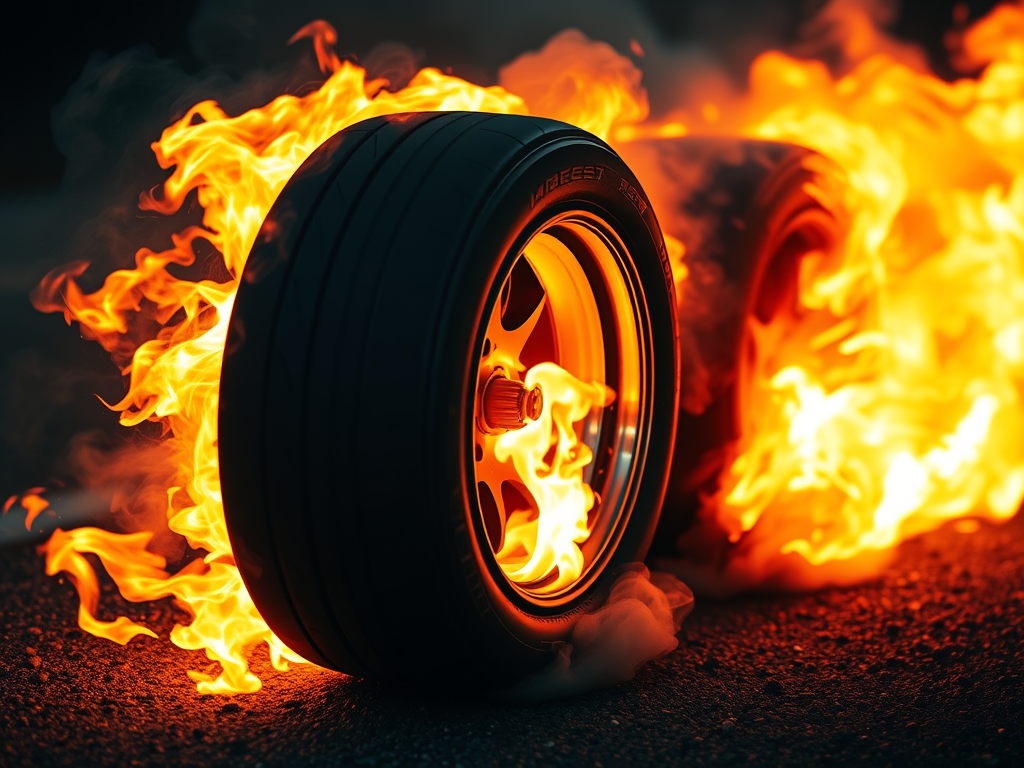
by Blue Dragon Racing
There’s a reason every serious sim racer ends up obsessing over numbers like 25.4 front, 25.1 rear.
Those few digits — PSI, or pounds per square inch — are not random.
They decide whether your car feels alive or lifeless, balanced or chaotic, connected or sliding.
In both sim racing and real GT3 competition, tire pressure isn’t a detail.
It’s the foundation of grip, balance, and confidence.
🔍 What PSI Really Means
PSI measures how much air is inside the tire — simple, right?
Not quite. That air defines how stiff or soft the tire feels, how large its contact patch is, and how quickly it heats up.
Think of it like tuning a drum skin.
Too loose, and it wobbles; too tight, and it rings without depth.
Somewhere in between lies harmony.
In Assetto Corsa Competizione, that harmony lives between 27.3 and 27.8 PSI (hot).
Below that, the tire deforms too much and overheats on its shoulders.
Above that, it balloons — only the center touches the tarmac, and grip falls off sharply.
⚙️ How PSI Affects Cornering
Tire pressure shapes how your car reacts to every steering input.
🔽 Low Pressure — More Grip, Slower Response
A soft tire spreads out and creates more mechanical grip, but feels lazy.
The steering has a small delay, the car rolls more, and exits feel heavy.
| Symptom | What’s happening |
|---|---|
| Slow turn-in | Sidewall flexes before biting |
| Stable but dull steering | Big contact patch, lots of drag |
| Understeer mid-corner | Front tires can’t react fast enough |
Low pressures look tempting, but over a race they overheat and wear faster.
🔼 High Pressure — Sharper, But Riskier
A stiff tire reacts instantly — and sometimes too fast.
You gain precision but lose forgiveness.
| Symptom | What’s happening |
|---|---|
| Nervous turn-in | Smaller contact patch |
| Snappy oversteer | Rear can’t absorb load transfer |
| Hot centers | Tire “balloons,” edges go cold |
High pressures can feel quick for one lap, then start to slide as heat builds up.
✅ The Sweet Spot
Between 27.3 and 27.8 PSI hot, everything clicks.
Temperatures stay even across the tread, steering feels natural, and you can repeat lap times effortlessly.
That’s the point where you stop fighting the car — and start dancing with it.
🧭 Qualifying vs Race Pressures
Pressure setup depends on time.
A qualifying lap and a race stint live in different worlds.
⚡ Qualifying Mode
- You need the tires to reach their window fast.
- Only two or three laps matter.
- The car is light and you drive aggressively.
Start with slightly higher cold pressures (e.g. +0.3–0.4 PSI) so the tires hit 27.5 hot within two laps.
You’ll get instant bite and rotation, even if they overheat afterward — because you won’t be out there long enough to care.
🕒 Race Mode
- The goal is stability, not fireworks.
- The stint may last 30–60 minutes.
- Tire temps rise slowly as fuel burns off.
Start with lower cold pressures (–0.3 to –0.5 PSI) to give room for expansion.
After 4–5 laps, they’ll settle right in the window — and stay there.
| Setup Goal | Cold PSI | Hot PSI | Behavior |
|---|---|---|---|
| Qualifying | 25.6–25.8 | 27.3–27.8 | Quick heat, max grip, short life |
| Race | 25.0–25.2 | 27.3–27.8 | Slow heat, consistent balance |
The same “perfect” hot pressure requires completely different starting points.
🌡️ Track & Air Temperature — The Invisible Hand
Ever wondered why your lap times suddenly drop by a full second on the same setup?
That’s not luck — that’s physics doing you a favor.
Tire pressure and temperature are married.
As air inside the tire warms up, it expands.
For every 10°C rise, pressure increases by about 0.25 PSI.
So when track temperature jumps from 20°C to 30°C, your hot pressures climb almost a full PSI — and the tire behavior changes completely.
| Change | PSI effect | What you feel |
|---|---|---|
| +5°C track temp | +0.3 PSI | Sharper steering, more grip |
| +10°C | +0.7 PSI | Feels faster, but risk of over-inflation |
| –5°C | –0.3 PSI | Slower warm-up, less grip |
| –10°C | –0.7 PSI | Tires stay blue, sluggish response |
That’s exactly why on Nürburgring GP, when the sun broke through and the asphalt warmed up for a few laps, I suddenly found a full second.
Tires did hit their thermal sweet spot — perfect PSI, perfect elasticity, perfect harmony.
⚙️ Adjusting for Conditions
| Track Temperature | Cold Pressure Adjustment |
|---|---|
| < 20°C | +0.2–0.3 PSI |
| 20–28°C | Baseline (25.2 F / 25.0 R) |
| > 30°C | –0.2–0.3 PSI |
Always watch the setup screen in ACC — that “Track Temp” value at the top right decides how your first three laps will feel.
🧠 The Golden Rule
Never tune camber, toe, or caster before your pressures are right.
Because until your PSI and temperatures are stable, the tire’s shape keeps changing — and every other setup value lies to you.
🧭 PSI Quick Summary — The Essence of Tire Pressure
- PSI (pounds per square inch) = determines tire stiffness and contact patch size.
- Ideal working range in ACC: 27.3–27.8 PSI (hot)
- Too low: more grip, slower response, higher wear.
- Too high: sharper steering, smaller contact area, less grip, nervous handling.
⚙️ Cornering Behavior
- Lower PSI = smooth, stable, slower steering.
- Higher PSI = sharp, twitchy, harder to control.
- Balanced PSI = natural feel, predictable grip, repeatable laps.
🕒 Qualifying vs Race
| Mode | Goal | Cold Start | Result |
|---|---|---|---|
| Qualifying | Fast warm-up for 2–3 laps | +0.3 PSI higher | Instant grip, short life |
| Race | Stable temps over time | –0.3 PSI lower | Consistent handling, long life |
🌡️ Track & Air Temperature
- Every +10°C raises pressure by ~0.25 PSI.
- Warm track → quicker heating, higher PSI.
- Cold track → slower heating, lower PSI.
- Adjust starting pressures accordingly:
- < 20°C → +0.2–0.3 PSI
- 20–28°C → baseline (25.2 / 25.0)
- 30°C → –0.2–0.3 PSI
🧠 Setup Logic
1️⃣ Fix PSI and temperatures first.
2️⃣ Only then tune camber, toe, caster.
3️⃣ Stable PSI = accurate data for the rest of the setup.
🏁 Key Takeaways
- Tire pressure defines grip, balance, and steering feel.
- Same hot PSI requires different cold PSI in qualy vs race.
- Track temperature can change lap time by a full second.
- PSI is where speed begins — everything else builds on it.
🧰 How to Adjust Tire Pressures — Step by Step
Getting tire pressures right isn’t about guessing numbers — it’s about reading what the tires tell you.
Here’s the clean, methodical way to do it in Assetto Corsa Competizione (and exactly how engineers do it in real life).
🔹 1️⃣ Start With Your Baseline Setup
- Use your current setup (no tweaks yet).
- Set your cold PSI values around 25.0–25.3 front and 24.8–25.1 rear (typical BMW M4 GT3 baseline).
- Check track temperature before going out — note it down.
💡 The goal isn’t to chase lap time yet. The goal is to collect temperature and pressure data.
🔹 2️⃣ Do a 4-Lap Run
- Drive 4 clean laps at normal race pace (not qualy push).
- Avoid sliding or locking up — you want realistic load, not overheating.
- After lap 4, return to the pits without resetting the setup screen.
Why 4 laps?
Because that’s how long it usually takes for the tires to reach their stable operating temperature (80–90°C) and hot PSI (27.3–27.8).
🔹 3️⃣ Read the Temperatures and Pressures
Now, in the setup menu → Tires section, look at each tire’s:
- Hot PSI
- Inside / Middle / Outside temperatures
You’re looking for:
- All 4 tires between 27.3 and 27.8 PSI (hot).
- Temperature spread: Inside > Middle > Outside, but only by 5–8°C difference.
💡 Example:
LF: 86 / 83 / 78 (perfect)
RF: 91 / 86 / 80 (a bit too hot → reduce camber or pressure)
LR: 78 / 76 / 75 (too cold → lower PSI slightly)
RR: 80 / 77 / 75 (good)
🔹 4️⃣ Balance Temperatures Side to Side
If one side of the car heats more than the other:
- That’s normal on asymmetric tracks (e.g., more right-hand corners).
- But aim to minimize the gap by fine-tuning camber and toe later.
For now, your only concern is that all four tires reach normal working range (80–90°C).
If a tire doesn’t reach 80°C after 4 laps, the PSI is too high → less friction, less heat.
If a tire goes over 95°C, PSI is too low → too much flex, overworking the rubber.
🔹 5️⃣ Adjust Rear Tires Slightly Lower
👉 The rear tires should usually run slightly lower pressures (about 0.1–0.2 PSI lower than the fronts).
Why?
- Under acceleration, rear tires heat up more and gain pressure faster.
- Lower starting PSI helps keep them stable and prevents rear-end snap oversteer.
💡 Example:
Front: 25.3 (cold) → 27.6 (hot)
Rear: 25.0 (cold) → 27.5 (hot)
This small offset helps the car rotate smoothly but stay stable on corner exit.
🔹 6️⃣ Iterate — Small Steps Only
After your first data run:
- Change pressures in 0.1–0.2 PSI increments only.
- Run another 4-lap test and repeat.
- Never change camber or toe yet — that’s next phase, after pressures are right.
Once all four tires reach the proper temperature range and you’re within 0.1–0.2 PSI across the set → congratulations, you’ve found your pressure balance.
🏁 Final Logic Recap
| Step | Goal | What to Look For |
|---|---|---|
| 1️⃣ Baseline setup | Establish cold PSI | Around 25.0–25.3 |
| 2️⃣ 4-lap run | Heat cycle the tires | 80–90°C range |
| 3️⃣ Read data | Identify hot PSI | 27.3–27.8 PSI |
| 4️⃣ Balance temps | Even heat across | 5–8°C inside–outside delta |
| 5️⃣ Adjust rears | Slightly lower | Prevent oversteer on exit |
| 6️⃣ Repeat | Fine-tune until stable | All 4 tires consistent |
💬 In Simple Terms
4 laps tell you the truth.
The tires will show you who’s working too hard and who’s on vacation.
Your job is to make them all work together — not too soft, not too stiff, just synchronized.
⏱️ Tire Life & Degradation — How Long Do They Last?
Even the perfect pressure won’t save a tire forever.
Every lap, every brake zone, and every slide eats away a little piece of rubber.
Understanding how long your tires actually last — and what happens as they wear — is the key to race consistency.
🧭 1️⃣ The Three Stages of Tire Life
🟢 Phase 1: Peak Grip (Laps 1–8)
- Tires are fresh, full of surface oils and elasticity.
- Pressures stabilize in the sweet zone (27.3–27.8 PSI).
- Grip is at its highest — braking feels solid, turn-in sharp.
💡 Use this phase for your fastest laps or qualifying push.
🟡 Phase 2: Plateau (Laps 8–25)
- The rubber surface stabilizes; the tire finds its rhythm.
- Temperatures and PSI fluctuate within ±0.2.
- Lap times stay consistent if you manage your driving.
- Overdriving or constant sliding will eat through this phase faster.
💡 This is where good drivers build their race — by being smooth, not necessarily fast.
🔴 Phase 3: Fade (Laps 25–45+)
- The tread layer starts to harden and lose elasticity.
- Heat cycles (repeated heating/cooling) make the tire less responsive.
- Temperatures rise faster, PSI increases more per lap.
- You’ll feel it: braking zones lengthen, the rear starts to float, and mid-corner grip fades.
💡 At this stage, fresh tires are worth seconds — not tenths.
⚙️ 2️⃣ How Long Do GT3 Tires Last in ACC?
| Track Type | Average Tire Life | Notes |
|---|---|---|
| Short Sprint (20–30 min) | Full grip all race | Minimal fade if PSI is correct |
| Medium Race (45–60 min) | Noticeable drop after ~40 min | 1–1.5 s slower near the end |
| Endurance (90+ min) | Heavy degradation | Mandatory tire change recommended |
| High-temp tracks (Barcelona, Paul Ricard) | 25–30 laps | Surface overheating accelerates wear |
| Cool tracks (Nürburgring, Silverstone) | 35–45 laps | Slower wear, more stable pressures |
💡 In most GT3 races, one set of tires comfortably lasts 60 minutes — but only if you keep them in the window.
🔥 3️⃣ What Causes Faster Wear
- Too low PSI → excess flex, sidewall overheating
- Too high PSI → center overheating, reduced contact patch
- Overdriving → frequent wheelspin and sliding generate surface heat spikes
- Trail braking too deep → kills front tires
- Aggressive throttle exits → kill rears
Smooth driving keeps the tire surface intact and temperature steady — and that’s what keeps your pace alive.
🧊 4️⃣ Heat Cycles and Aging
Every time a tire heats to 90°C and cools down, it hardens slightly.
That’s called a heat cycle.
In endurance races, or practice sessions with reused sets, you’ll notice:
- Less initial bite,
- Slower warm-up,
- Shorter peak phase.
💡 Engineers call it “tire aging.”
In ACC terms, think of it as invisible wear — grip just slowly disappears even if tread looks fine.
🏁 5️⃣ How to Extend Tire Life
✅ Keep hot PSI in range (27.3–27.8).
✅ Avoid excessive sliding — drive the car through the tires, not against them.
✅ Lift slightly earlier, brake smoother — save 3–4°C per lap.
✅ Use kerbs gently — bouncing the tire raises internal temps.
✅ Balance the car so all four tires wear evenly (front-left is usually the killer).
⚡ In Simple Terms
Perfect PSI gives you peak grip.
Consistent temperature gives you long life.
Smooth driving gives you both.
If you treat your tires like they need to survive a story — not just a stint — they’ll reward you with lap after lap of confidence and pace.
That’s when consistency beats aggression, and physics finally feels like an ally.
🏁 Closing Thoughts
When I first started digging into tire pressures, I honestly didn’t believe how deep this topic goes.
It’s not just about a few PSI numbers — it’s a whole world of physics, rhythm, and feel that decides whether you drive with the car or against it.
There’s no way to cover everything about tires in a single post.
For now, I’m taking what I’ve learned here to my next race — a little smarter, a little more aware.
Next time, I’ll dive into toe and camber, and how they complete the story that PSI begins.
If this topic speaks to you, leave a comment, share your thoughts, and let’s explore it together.
Right now, I’m armed mostly with theory and small bits of experience —
but by the end of this season, I want to truly understand what happens underneath my car.
This isn’t just for me — it’s for all of us who love the feeling of learning lap by lap.
See you on track. 🏎️💨
#BlueDragonRacing, #SimRacing, #AssettoCorsaCompetizione, #ACCSetup, #TirePressure, #PSI, #SimRacingTips, #RacingPhysics, #GT3, #SimRacerLife, #TrackTemperature, #RaceEngineering, #RacingSetup, #TireScience, #SimRacingCommunity, #Sceleton1_0, #RacingEducation, #RacingMindset, #LearnAndRace, #RacingJourney
Leave a Reply