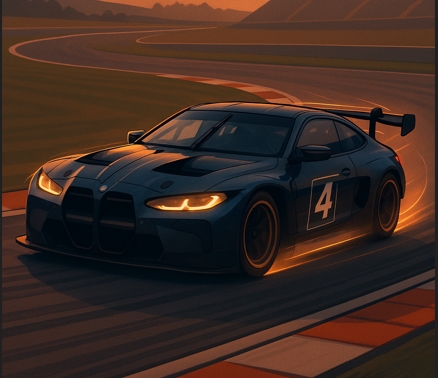
I’ve always liked Red Bull Ring.
Maybe because I know it so well — in GT7 I can comfortably lap between 1:29 and 1:30.5, depending on the car.
It’s fast, clean, and logical. Every corner has purpose.
In ACC, it’s the same — but sharper.
And this time, I decided to apply my own theory.
1. Tire Pressure — the Real Starting Point
It’s easy to think you can just copy a preset.
But the truth? If your pace isn’t there yet, the preset doesn’t fit.
So I raised the tire pressures right after my first test — and instantly felt the difference.
The car came alive. Stable temps, predictable grip, and no sluggish transitions.
2. Camber and Caster — Listening to the Track
Next came camber.
I adjusted it to get that extra bite mid-corner — enough to load the front without burning the edges.
And for the first time, I dared to soften the caster a little.
Red Bull Ring has a couple of fast direction changes, and that small tweak made the steering calmer, smoother, more natural.
3. Toe and TC — Less Control, More Freedom
I left the toe mostly untouched — no need to chase ghosts when the car already behaves.
But traction control — that’s where speed hides.
I moved from TC 6 to TC 4, and suddenly the car pushed harder out of the corners, no hesitation, just clean drive.
4. ABS — The Final Link
ABS 1 felt fine before, but with better tire temps, I could afford ABS 2.
That meant shorter braking zones and a more confident turn-in.
5. Fuel Logic — Racing the Math
Fuel is always the silent variable.
Right now, my calculations show 2.69 L per lap, but as the race goes on and grip improves, so does speed — and fuel use.
So I’m planning 2.77 L/lap to play it safe.
I’d rather cross the line with a drop left than a dry tank.
6. The Result
Lap time: 1:30.6, and I can feel 1:30.0 waiting.
But this isn’t about chasing a number anymore.
It’s about knowing why the number changes.
Every click, every PSI, every liter — they all talk.
And when you finally understand their language, the car doesn’t just go faster — it becomes you.
Leave a Reply