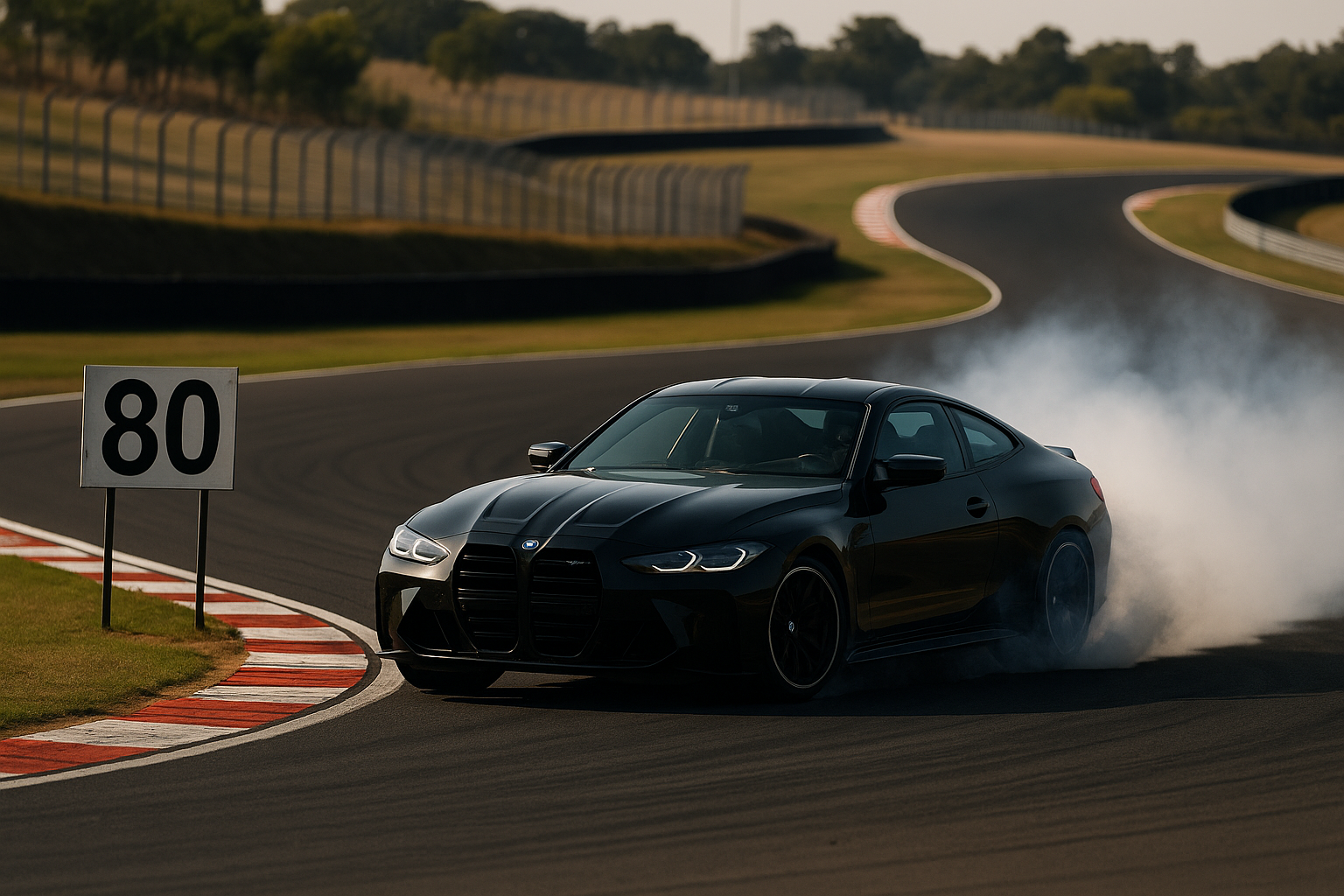
There are moments in sim-racing when you realise that everything you thought you understood… was only half the truth.
Red Bull Ring was my moment.
Kyalami became the revelation.
Before the race, I promised myself one thing:
I will finally understand why my car isn’t fast.
Not the laptime. Not the line.
The car — and my driving.
Oddly enough, the whole journey began with tyre pressures.
For years, PSI was just numbers.
Then Kyalami — the perfect testing track — revealed the real pattern:
The outside tyres should often run slightly lower pressure than the inside tyres.
Why?
Because they carry the rotation load.
At Kyalami, this alone improved my pace by 4.5 seconds before the race even began.
But that was not the big discovery.
Something much deeper was waiting.
A truth no sim-racing coach ever seems to actually teach.
SO… WHAT IS THE REAL OBJECTIVE IN RACING?
People talk about braking points.
Rotation.
Trail braking.
Corner exits.
All useful words — but none of them explain the why.
And then it hit me:
Almost every coach teaches what’s important to them,
but not what is important to you and me as drivers trying to learn real physics.
So let’s break it down properly — the part no one explains.
THE ESSENCE OF CIRCUIT RACING (THE PART EVERYONE SKIPS)
First truth:
You cannot download someone else’s setup and expect it to work.
Your driving style is unique.
Your inputs, your timing, your confidence — all different.
Second truth:
The goal of racing is not “brake at 100m.”
The goal is to get through the corner as fast as physics allows —
with the smallest steering input possible.
Because:
- Every extra steering movement slows the car
- Every correction kills speed
- Every unnecessary rotation is lost time
So the real goal becomes simple:
Turn as little as possible.
Brake as little as necessary.
Rotate the car as efficiently as possible.
Rotation is the holy grail.
THE GREAT LIE OF THE BRAKING POINT
Beginners learn:
“Brake at 100 metres.”
But braking points are not sacred.
They are not laws.
They are just references.
If you can safely brake at 100m,
then with correct rotation and setup,
you should also be able to brake at 80m.
So why do fast drivers brake later?
It’s not better brakes.
It’s not magic setups.
And it’s not bravery.
It’s because:
They rotate the car before braking even finishes.
They deliberately create controlled instability.
Enough for the car to want to turn.
Gran Turismo never teaches this — it’s too polite.
ACC teaches it instantly — by humiliating you.
You see someone brake at 70m.
You try it.
You die.
But what they actually did was:
- destabilise the car early
- let the chassis rotate naturally
- need almost no steering
- go to throttle earlier
That’s why they’re fast.
CONTROLLED INSTABILITY — THE SECRET TO REAL SPEED
A top driver does not “turn” the car.
A top driver lets the car rotate.
They create just enough body roll and instability
for the car to rotate without large steering input.
If you’re turning the wheel a lot, you are already slow.
If the car rotates itself, you are already fast.
This is the true essence of racing.
WHY MINIMAL STEERING IS A SUPERPOWER
Here’s the part almost no one mentions:
Minimal steering isn’t just faster.
It improves everything.
1. Far less tyre wear
Less steering → less scrub → longer tyre life.
2. You can accelerate earlier
If the tyres are already pointed almost straight at the apex,
you can go to throttle without drama.
3. You don’t spin
Most spins happen from throttle + too much steering angle.
Small angle = stable rear = no spin.
4. More even tyre temperatures
Less scrubbing = smoother temps.
5. Lower fuel consumption
Better rotation → easier acceleration → less throttle → less fuel burned.
Minimal steering = maximum efficiency.
HOW TO ACTUALLY PRACTICE THIS (THE REAL TRAINING METHOD)
If you can take a corner braking at 100m,
then you must be able to take it at 80m with correct rotation.
Here’s the method:
STEP 1: Drive Normally
Run laps the way you always do.
Get consistent.
Get comfortable.
STEP 2: Reduce Your Braking Distance by 20%
If it’s 100m → move to 80m.
Not 95.
Not 90.
Eighty.
Your goal is NOT to go faster.
Your goal is to achieve the same lap time you had before.
This forces rotation, trail braking, and real understanding.
STEP 3: Change the Setup to Make This Possible
To survive the new braking point, adjust the car:
- more body roll
- less steering needed
- more natural rotation
- outside tyres slightly lower PSI
- front not collapsing, not resisting rotation
For the first 100 laps?
You will go off.
Often.
Spectacularly.
But slowly…
- you start trail braking naturally
- you rotate without thinking
- you steer less
- you accelerate earlier
- you use less track
- your lap times drop
And this is when you finally understand:
Rotation was the lesson all along.
CONCLUSION — WHAT KYALAMI TAUGHT ME
This is the difference between regular drivers and top-level aliens:
Not bravery.
Not talent.
Not even setups.
But the ability to:
- rotate the car early
- steer less
- use controlled instability
- let the tyres work properly
- go to throttle earlier
This is real circuit racing.
And once you truly see it,
you’ll never look at braking markers the same way again.
WHAT’S NEXT — ENTER THE SETUP WORLD: THE ANTI-ROLL BAR
Now that we finally understand what real speed comes from —
rotation, minimal steering, controlled instability, PSI balance —
we are finally ready to open the door to the next world:
Setup.
But not setup the way most people use it.
Not “download alien setup from YouTube.”
Not random sliders.
Not superstition.
I mean the real setup world — the part that actually matters,
because now we know what the car must do:
👉 offer optimal body roll
👉 let the car rotate naturally
👉 prevent the nose from diving too deep
👉 keep the rear from stepping out uncontrollably
And that brings us to the next chapter:
THE ANTI-ROLL BAR
What it actually does,
how it shapes rotation,
and why it might be the most misunderstood tool in all of sim racing.
That’s coming next.
And it’s a big one.
AND ONE LAST THING — YOUR RIG MATTERS MORE THAN YOU THINK
Everything we explored —
the micro-rotation,
the minimal steering,
the weight transfer,
the PSI balance,
the controlled instability —
all of it depends on one thing:
You cannot feel any of this if your rig is flexing.
A soft rig hides rotation.
A wobbling rig kills trail braking.
A shaking pedal plate destroys brake consistency.
A bending frame lies to you about weight transfer.
That’s why I built the Sceleton 1.0:
- rock-solid pedal plate
- stable enough for trail braking drills
- rigid enough to feel the instant weight transfers
- comfortable enough for 100-lap test sessions
If you want to master rotation —
if you want to push braking from 100m to 80m —
if you want to feel what the car is actually doing…
👉 you need a rig that doesn’t move when you do.
Sceleton 1.0 — engineered to teach you real racing
Check it out: bluedragonracing.eu
And next time…
we open the toolbox and dive into the Anti-Roll Bar,
the rotation shaper.
Let’s keep racing, dragons. 🐉🔥
Leave a Reply