
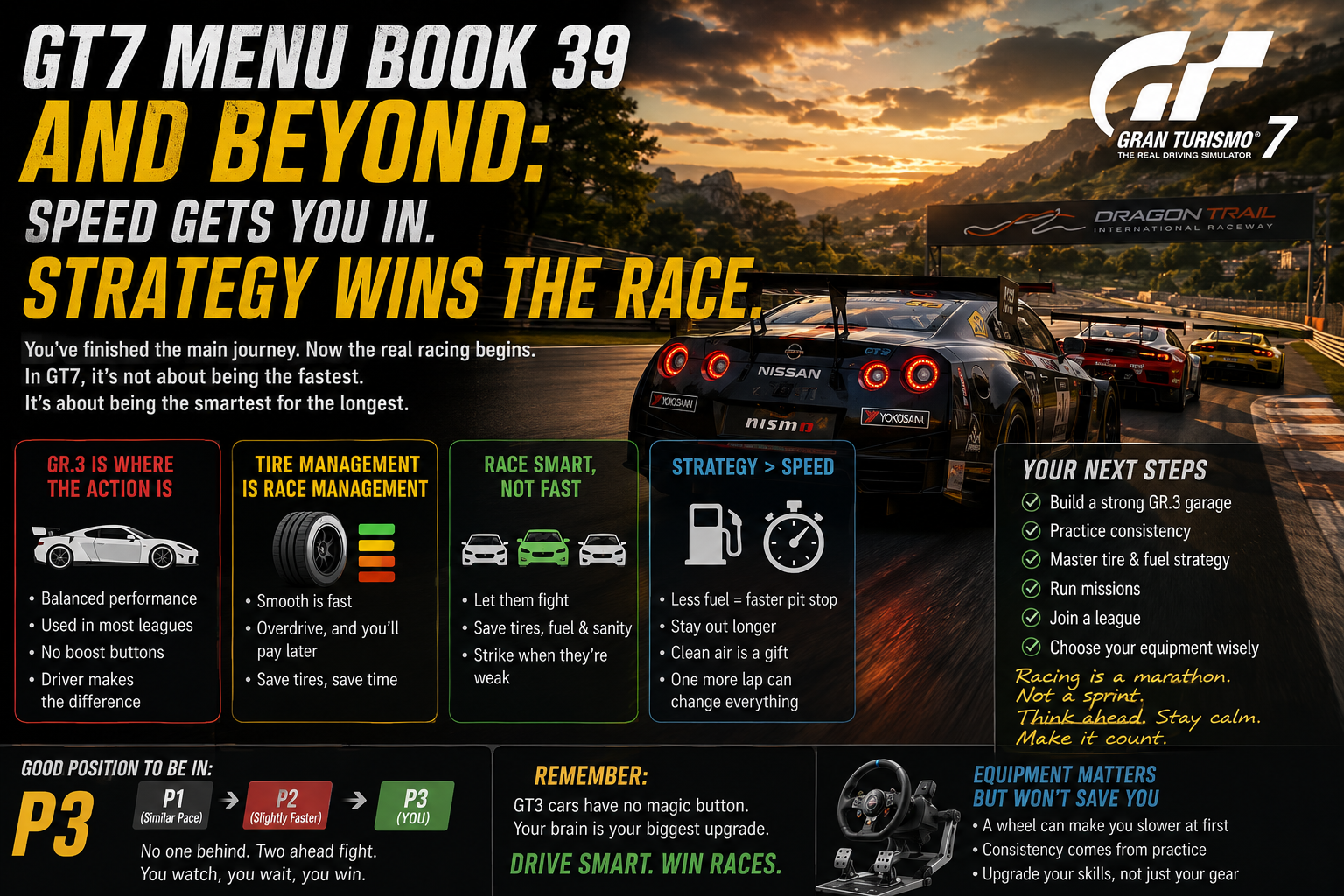
Menu Book 39 is where Gran Turismo 7 politely stops holding your hand.
The Café journey is finished. Car selling is available. Sport Mode is open. Your garage is full of machines you cannot remember winning, buying or accidentally painting metallic purple at two in the morning.
The game has taught you how to drive.
Now it expects you to race.
These are not the same thing.
Driving is about braking at the correct marker, clipping the apex and avoiding the gravel trap.
Racing is about doing all of that while another person is attempting to occupy the exact piece of tarmac you had selected.
It is about tires, fuel, traffic, pressure, patience and knowing when absolutely nothing is the correct thing to do.
If you have reached Driver Rating B, you are already reasonably fast.
Congratulations.
Unfortunately, everyone around you is now reasonably fast too.
Your next step is not more speed.
It is learning what to do with the speed you already have.
🏎️ The Road Eventually Leads to Gr.3
GT7 contains tiny hatchbacks, old American muscle cars, Japanese legends, classic racers, prototypes and machines that appear to have been designed using nothing but carbon fibre and anger.
But once you move into regular online competition, one category begins appearing again and again:
Group 3.
There is a good reason for this.
Gr.3 cars are fast enough to feel serious, but not so absurd that every corner becomes an aerodynamics lecture.
They have proper racing brakes, downforce, slick tires and enough power to punish stupidity immediately.
They are also used extensively in Sport Mode, manufacturer competitions and organised online leagues.
So when you begin deciding which cars to collect, do not treat Gr.3 machines as just another section of the dealership.
They are the working tools of GT7 competition.
You do not need every Gr.3 car immediately. You do need to begin understanding the category.
Different Gr.3 cars behave very differently:
- Front-engine cars are often stable and predictable.
- Mid-engine cars can rotate beautifully and then attempt to murder you.
- Some cars are excellent on fuel.
- Some preserve their tires.
- Some are fast in qualifying but difficult over a long stint.
- Some are not spectacular anywhere but remain irritatingly competent everywhere.
That final type is often the most useful.
A league season is not won by choosing the car that produces the most impressive single lap in a YouTube video.
It is won by choosing the car you can understand for an entire race.
⚡ Speed Gets You to B
Driver Rating B means you have developed pace.
You can probably qualify reasonably well. You know the braking points. You understand racing lines. You can follow another car without immediately driving into its boot.
This is progress.
But DR B is also where one painful truth becomes obvious:
Your fastest lap is not nearly as important as you thought it was.
One driver may produce a 1:40.0 and then complete the next five laps in 1:41.8, 1:42.4, 1:40.9, 1:43.1 and, after visiting a sausage kerb, next Thursday.
Another driver may run six laps between 1:40.8 and 1:41.2.
The first driver gets the screenshot.
The second driver gets the result.
Races are not decided by the best lap.
They are decided by the sum of all the laps, including the ugly ones, the defensive ones and the ones completed while somebody in a brightly coloured Porsche is filling your mirrors.
🛞 Your Tires Are Not an Infinite Resource
A fresh tire is a wonderful thing.
It grips, turns and forgives.
Then you begin abusing it.
You enter corners too quickly. You drag the front tires across the surface. You spin the rears on exit because the throttle apparently only has two positions: closed and national emergency.
The tire does not complain.
It simply becomes slower.
Tire preservation is not about crawling around the circuit as though transporting a wedding cake.
It is about removing unnecessary violence.
You preserve the front tires by:
- Braking slightly earlier and releasing the brake smoothly
- Avoiding excessive entry speed
- Using one clean steering input instead of three corrections
- Refusing to force the car toward an apex it has already missed
- Avoiding long periods of understeer
You preserve the rear tires by:
- Applying throttle progressively
- Short-shifting when traction is limited
- Avoiding wheelspin
- Using the car’s rotation instead of correcting everything with power
- Accepting that full throttle is not a human right
The quickest drivers over a full stint are often not attacking every corner.
They are asking less from the car.
And because they ask less, the car continues giving them more.
🧠 The Best Seat in the Race May Be Third
Imagine the following situation.
You are running third.
The leader is driving at roughly your pace.
The car in second is slightly faster and is attacking the leader.
There is nobody close behind you.
Most inexperienced drivers see this and think:
“I must join the battle immediately.”
This is because most inexperienced drivers are idiots.
You are already in the best possible position.
The two cars ahead are fighting.
They are braking later, taking defensive lines, compromising their exits and repeatedly placing their tires under unnecessary load.
They are using more fuel.
They are losing time.
You, meanwhile, can sit behind them in relative peace, save tires, save fuel and watch the situation become progressively worse for both of them.
Your goal is not to set the fastest lap.
Your goal is not even necessarily to overtake immediately.
Your goal is to remain close enough to benefit when the fight produces an opportunity.
Long races are marathons.
Treating every lap like the final corner of a sprint race is an excellent way to become very fast for eleven minutes and very slow for the remaining thirty-nine.
🍿 Let Them Fight
When two cars are battling ahead, the most intelligent move is often to wait.
This feels wrong because racing games train us to attack anything visible.
But while those drivers are defending and counterattacking, several useful things are happening.
They are:
- Overheating their tires
- Using additional fuel
- Compromising their lines
- Increasing their risk of contact
- Losing overall race time
- Becoming emotionally invested in defeating each other
You are simply observing.
You can remain close without forcing the issue. Lift slightly before braking zones. Use the slipstream. Avoid sliding. Allow the fight to pull you along while consuming less fuel.
This is not weakness.
It is exploitation.
You are allowing two other drivers to damage their own races for your benefit.
Very generous of them.
🎯 Attack After the Overtake
Eventually, the faster car in second will probably overtake the leader.
This is the moment the situation changes.
The new leader may begin escaping.
The overtaken driver may be unsettled, defending badly or struggling with tires that have already endured several laps of combat.
Now you attack.
Not because your car has suddenly gained more horsepower, but because your resources are in better condition.
Your tires are fresher.
You have used less fuel.
You have not spent five laps attacking from compromised lines.
Your task is to find a clean opportunity, pass the slower car and reach the new leader before the gap becomes too large.
This is where patience becomes speed.
The laps you spent waiting were not wasted.
They created the advantage you are now using.
🧲 Catch the Leader — Then Think Again
Suppose you reach the leader.
He notices you.
He begins defending.
Many drivers immediately repeat the earlier mistake and attempt to pass at every corner.
But a defending car can be useful.
You can follow in the slipstream, save fuel and reduce the amount of time spent at full throttle.
You may be able to preserve the tires by avoiding unnecessary lunges.
The leader is now doing extra work.
He is checking his mirrors, covering the inside and compromising his own racing line.
You are applying pressure without necessarily attacking.
This can be more effective than sending the car into a gap that exists only in your imagination.
Your goal is not to prove you could attempt an overtake.
Your goal is to create the best possible race outcome.
Sometimes that means passing on track.
Sometimes it means forcing the other driver to damage his tires.
Sometimes it means waiting for the pit window.
⛽ Fuel Saving Is Free Pit-Lane Speed
Fuel saving sounds dull because it is usually discussed using words such as “consumption targets” and “lift-and-coast.”
But the result is wonderfully simple.
If you use less fuel on track, you need less fuel in the pit lane.
If you need less fuel in the pit lane, your stop is shorter.
A driver may defend brilliantly for twenty laps and then lose the position while standing still as fuel is poured into the car.
This is one of the great pleasures of strategy.
You do not always have to pass the other driver.
Sometimes you simply arrange for the pit crew to do it.
Useful fuel-saving techniques include:
- Lifting before the braking zone
- Using the slipstream
- Short-shifting
- Avoiding unnecessary acceleration followed immediately by braking
- Remaining calm when following another car
- Choosing moments to attack rather than attacking continuously
The important point is to save fuel without losing the tow.
If you save so aggressively that the leaders escape, you have not created a strategy.
You have created a scenic drive.
🔄 The Overcut: One More Lap Can Change Everything
Tire preservation gives you another strategic option.
Suppose the driver ahead pits.
Your tires are still functioning because you have spent the stint driving intelligently rather than attempting to remove the tread manually.
You stay out for one additional lap.
Now you are driving in clean air.
There is no defending car ahead. No dirty air. No compromised line. No queue into the pit entry.
You can complete one strong lap and pit later.
Because you saved fuel, your refuelling time may also be shorter.
Because you stayed out longer, you may return to the circuit in clear space rather than directly behind traffic.
This is the overcut.
It is not guaranteed to work. Cold tires, traffic and pit-loss differences all matter.
But when it works, it feels vastly more satisfying than a desperate dive into a braking zone.
You have not bullied your way past.
You have arranged the race so that the other car is no longer in front of you.
Much more civilised.
🌬️ Clean Air Is a Strategic Asset
Drivers often think only about track position.
But the position in which you return to the circuit matters almost as much as the number beside your name.
A slightly later stop can allow you to avoid traffic.
That means:
- Cleaner air
- Better visibility
- More consistent braking
- Less time fighting slower cars
- Lower tire temperatures
- Freedom to use the ideal line
Returning from the pits behind a group of battling cars can destroy an otherwise excellent strategy.
You may have fresher tires, but you cannot use them because the circuit is occupied by people disagreeing loudly over tenth place.
Staying out one lap longer can sometimes place you into an empty section of track.
That is often worth more than the theoretical advantage of pitting at the earliest possible moment.
🏁 Gr.3 Cars Have No Magic Button
In some forms of racing, a driver can press a button and receive additional electrical power.
Gr.3 cars generally do not offer this luxury.
There is no magical boost waiting to rescue a poor exit.
No temporary burst of energy to correct a bad strategic decision.
You have an engine, tires, fuel and your own judgement.
That is why the category works so well.
The cars are close enough in performance that the result frequently comes down to the driver’s decisions:
- When to attack
- When to wait
- When to save fuel
- When to protect the tires
- When to pit
- When to stay out
- When to defend
- When to accept that defending will only make the eventual defeat slower and more embarrassing
Raw speed matters.
Of course it does.
But in a long Gr.3 race, the quickest driver may lose to the driver who understood the race better.
The stopwatch measures pace.
The finishing order measures everything.
🎮 Missions Teach Control — Leagues Teach Consequences
If you want to develop beyond DR B, GT7 Missions remain useful.
They teach fuel saving, tire management, overtaking, changing conditions and driving unfamiliar machinery.
They force you to solve problems rather than simply install more power.
But organised online leagues provide the real next step.
In a league, you race the same drivers repeatedly.
They learn your habits.
You learn theirs.
There are points, standings, rivalries and consequences.
A poor decision does not disappear when you leave the lobby. It follows you into the championship table.
League racing teaches:
- Long-term consistency
- Race preparation
- Strategy
- Stewarded driving
- Tire and fuel management
- Adaptation across different tracks
- The value of finishing
- The pain of throwing away twenty minutes of good work in one braking zone
Daily Races teach you how to compete.
League racing teaches you how to build a season.
🛠️ Think About Equipment Before the League Begins
A controller can be extremely fast.
There is nothing shameful about using one.
But before committing to league racing, you should think seriously about the equipment you want to use long term.
Moving from a controller to a wheel is not an instant upgrade.
It is a reset.
With a controller, your thumbs already understand steering. Your fingers know the triggers. Corrections happen almost automatically.
A wheel changes the physical language of driving.
You now steer with your arms.
You brake with your leg.
Your seating position matters.
The pedals must remain still.
The wheel communicates grip through force feedback.
A slide that required a tiny thumb movement may now require a large and immediate correction.
At first, you will probably become slower.
This is normal.
You have not purchased speed.
You have purchased the opportunity to relearn everything.
Do not change from controller to wheel immediately before an important league season and expect the box to contain three seconds per lap.
It does not.
It contains cables, mounting hardware and a temporary identity crisis.
🔧 What You Actually Need
You do not need the most expensive equipment available.
You need equipment that behaves the same way every lap.
The priorities are simple:
- A stable seating position
- Pedals that do not move
- A wheel that provides clear feedback
- A brake you can operate consistently
- Comfortable ergonomics
- Settings that remain unchanged long enough for you to learn them
A load-cell brake can improve consistency because it responds to pressure rather than only travel.
But it needs a stable rig.
A stronger wheelbase can provide more detail.
But stronger is not automatically better if you spend the race wrestling it like an escaped farm animal.
Equipment should make inputs repeatable.
It should not become the most difficult opponent on the circuit.
📈 Your New Progression Path
After Menu Book 39 and Driver Rating B, the game’s official progression matters less.
Collector Level 50 remains useful. Weekly Challenges, Extra Menus and further collecting will continue expanding your garage.
But your real development now follows a different path.
Build a Gr.3 Garage
Choose a small number of cars with different characteristics.
Learn which cars suit your driving and which are useful across league formats.
Do not collect them only because they look impressive in the garage.
Collect them because you understand what each one can do.
Develop Consistency
Run full stints.
Stop restarting every time the first lap is imperfect.
Measure your average pace, not only your best lap.
Learn Tire and Fuel Management
Practise lifting early, short-shifting and following in the slipstream.
Learn how the car changes as the stint develops.
Complete Missions
Use them as controlled lessons in adaptability.
Join a League
Choose structured racing where strategy, preparation and consistency matter.
Upgrade Equipment Carefully
Change your equipment when you have time to rebuild your muscle memory, not when you expect immediate results.
🏆 What Makes a Real Racing Driver?
A real racing driver is not simply the person who can produce the fastest lap.
It is the driver who understands the entire race.
The driver who can:
- Remain close without overheating the tires
- Watch two rivals fight without joining unnecessarily
- Save fuel while maintaining the slipstream
- Attack immediately when the opportunity becomes valuable
- Pressure a leader without destroying the car
- Extend the stint when clean air becomes available
- Spend less time refuelling
- Rejoin away from traffic
- Adapt when the original strategy stops working
- Finish the race with enough tire left to fight
Fast drivers create impressive moments.
Smart drivers create results.
The very best drivers do both.
💬 Final Thoughts: The Race Is Not a Time Trial With Traffic
Menu Book 39 completes GT7’s guided progression.
Everything beyond it is where you decide what kind of driver you want to become.
You can continue collecting cars.
You can move toward Collector Level 50.
You can complete Weekly Challenges and Missions.
But if you want to become genuinely competitive, your attention should move toward Gr.3 racing, consistency and strategy.
Do not obsess over producing the fastest lap.
A long race is not twenty qualifying sessions placed one after another.
It is a problem that changes every lap.
Sometimes the correct move is to attack.
Sometimes the correct move is to save fuel.
Sometimes the correct move is to sit in third place and watch the two drivers ahead destroy each other’s tires.
Then, when the moment arrives, you pass one, catch the other, shorten your fuel stop, extend your stint and return to the track in clean air.
No boost button.
No purchased advantage.
No magic.
Just the driver deciding what happens next.
Speed gets you into the fight.
Consistency keeps you there.
Strategy wins it.
Orrak1
bluedragonracing, granturismo7, gt7community, menubook39, gr3, groupracing, tiremanagement, fuelstrategy, driverratingb, leagueracing, racecraft, sportmode, simracer, simracing
Leave a Reply