
By Blue Dragon Racing
Do you remember when your parents told you not to eat Tabasco sauce with a spoon?
The people who listened probably had a much easier evening.
Caster works in much the same way.
You do not need much of it, and if you go too far, you will remember the mistake for the rest of the session.
Caster Is the Tabasco of Your Setup
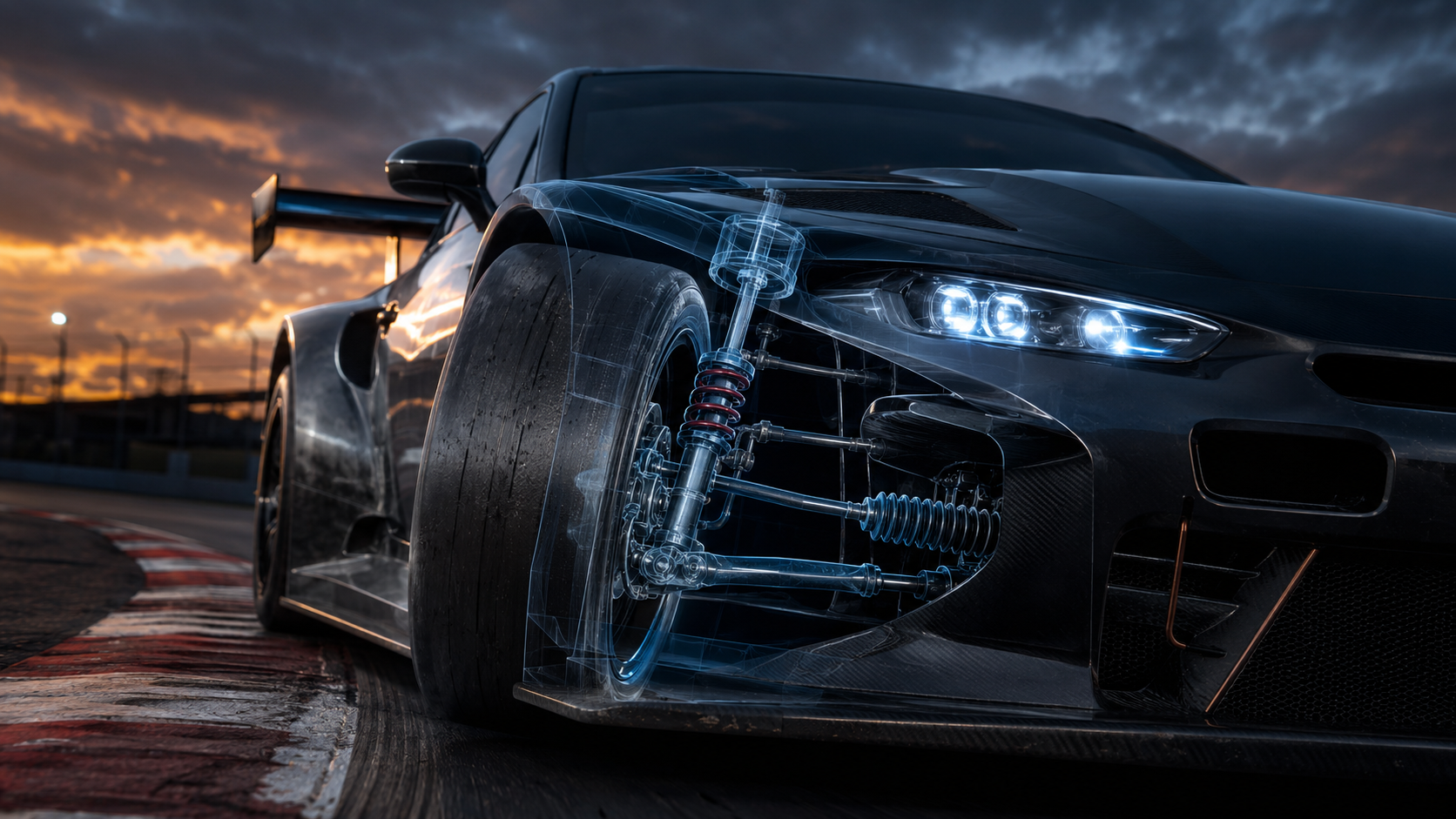
Caster is the angle of the front suspension’s steering axis when viewed from the side of the car.
It influences how strongly the steering returns toward the centre, how much weight you feel through the wheel and how stable the car remains at speed.
In simple terms, caster helps connect your hands to the front tires.
Most GT3 cars in Assetto Corsa Competizione already use a strong positive caster angle. A value around 8.7 degrees is a common baseline and is usually well balanced.
That is why caster should be treated carefully.
Unless the steering genuinely feels wrong, the default setting is often the best place to leave it.
Caster is not usually the first setting to change. Tire pressures and camber have a much greater influence on the tire’s basic contact with the road. Caster is a fine-tuning tool for steering feel, stability and consistency.
What Positive Caster Does
Positive caster places the upper part of the steering axis behind the lower part.
This creates a self-centring effect.
It is similar to the geometry used on the front wheels of a shopping trolley, although a racing suspension is obviously far more sophisticated.
As the car moves, positive caster encourages the wheels to return toward the straight-ahead position.
This can provide:
- Stronger self-centring
- Better straight-line stability
- More steering weight
- Clearer feedback under load
- Improved confidence through fast corners
Caster also creates dynamic camber as the wheels turn.
When steering input is applied, the outside front tire can gain additional negative camber. This may help the tire maintain grip during cornering.
However, every benefit comes with a compromise.
More caster does not automatically mean more grip or faster lap times.
What Happens When You Reduce Caster
Reducing caster makes the steering lighter.
The front wheels require less effort to turn, which can make the car feel agile in slow corners and tight chicanes.
However, too little caster may remove much of the steering’s natural weight and self-centring behaviour.
The car may begin to feel:
- Light through the wheel
- Vague around the centre
- Nervous on straights
- Difficult to place consistently
- Less communicative near the grip limit
The steering may initially feel quicker, but the car can also become harder to trust.
A small steering movement may produce a fast response without giving enough feedback about what the tires are doing.
The car turns, but the driver receives less information.
That is why reducing caster can make the car feel as though it has lost some of its character.
What Happens When You Increase Caster
Increasing caster normally adds steering weight and stronger self-centring.
The car may feel more planted, stable and deliberate.
This can be useful in high-speed corners and heavy braking zones, where confidence in the front axle matters.
However, too much caster can create new problems:
- Heavy steering
- Slower response in tight corners
- Increased physical effort
- Higher front-tire temperatures
- Excessive dynamic camber
- Reduced agility in hairpins
At first, high caster can feel impressive.
The wheel feels solid. The car appears stable. Every input carries weight.
After several laps, however, the front tires may begin overheating and the steering may become unnecessarily tiring.
It is the setup equivalent of adding too much spice.
The first bite feels powerful.
Halfway through the meal, you begin questioning the decision.
Where Caster Actually Helps
Caster rarely creates a dramatic improvement in one isolated corner.
Its value appears through consistency.
It helps the steering behave predictably across an entire lap and allows the driver to build a repeatable rhythm.
Fast Direction Changes
Circuits such as Silverstone and Suzuka contain rapid direction changes where steering balance is critical.
Examples include:
- Silverstone, Maggots and Becketts
- Suzuka, the Esses
- Circuit of the Americas, the opening sector
In these sections, additional caster may help smooth the transition from one direction to the other.
The steering feels weighted rather than nervous.
Instead of reacting to every movement, the car takes a more deliberate set before changing direction.
This can create:
- Smoother steering inputs
- More even tire loading
- Fewer corrections
- Better rhythm
- More repeatable lap times
The goal is not to make the car slow to respond.
The goal is to remove unnecessary twitchiness.
Heavy Braking
Caster can also improve confidence during heavy braking.
Tracks such as Monza and the Red Bull Ring contain braking zones where the car must slow from very high speed while remaining straight and stable.
A suitable caster setting strengthens the steering’s self-centring effect.
The car is less likely to wander under braking, and the driver can feel more confident applying pressure.
This matters because late braking begins with trust.
A driver will not consistently brake near the limit if the front end feels vague or unstable.
Caster does not shorten the braking distance by itself.
It gives the driver a clearer and more stable platform from which to use the brakes.
High-Speed Corners
Fast circuits such as Spa-Francorchamps and Paul Ricard place sustained load through the front tires.
In these conditions, higher caster may provide a heavier and more informative steering feel.
The driver can sense the front axle loading up and understand how much grip remains.
This changes the driving experience.
Instead of waiting for the car to slide and then reacting, the driver begins anticipating the loss of grip.
That is where consistency starts.
The steering stops being only a control device and becomes a source of information.
The Trade-Off
Caster always involves a compromise.
| Too Little Caster | Too Much Caster |
|---|---|
| Light, quick steering | Strong straight-line stability |
| Nervous behaviour | Heavy steering |
| Reduced feedback | Higher front-tire temperatures |
| Harder to hold a precise line | Slower rotation in tight corners |
| Less self-centring | Greater physical effort |
| More agility at low speed | More confidence at high speed |
Less caster can make the car feel more eager.
More caster can make it feel more disciplined.
Neither extreme is ideal.
The fastest setup is usually the one that gives enough steering weight and stability without making the car slow, hot or exhausting to drive.
Less caster makes the car dance.
More caster makes it march.
Balance is what wins the race.
Typical Track Logic
Caster requirements depend on the circuit.
The following values should be treated as starting points rather than fixed answers.
| Track | Possible Caster Range | Main Reason |
|---|---|---|
| Silverstone | 9.8°–10.0° | Stability through rapid direction changes |
| Red Bull Ring | Around 8.7° | Agility in slower corners |
| Monza | Around 9.2° | Confidence during heavy braking |
| Spa-Francorchamps | Around 9.8° | High-speed balance and steering feel |
| Imola | Around 8.8° | Quicker rotation through chicanes |
The correct value also depends on the car.
A front-engine GT3 car may tolerate or benefit from a different caster setting than a mid-engine car.
Force-feedback settings also matter. A caster value that feels comfortable on one wheelbase may feel excessively heavy on another.
Do not copy a number without understanding how it affects your own car and hardware.
Caster and Dynamic Camber
One reason caster matters is its relationship with camber.
When the wheels turn, positive caster changes the wheel angle relative to the road.
The outside front tire gains additional negative camber, while the inside tire moves in the opposite direction.
This can help the outside tire remain loaded during cornering.
However, excessive caster can also generate too much dynamic camber.
That may cause the inside edge of the front tire to work too hard, especially in long corners.
This can lead to:
- Higher inside-edge temperatures
- Uneven tire wear
- Reduced straight-line contact
- Increased steering effort
- Front-tire overheating
This is why caster should be adjusted only after pressures and static camber are already in a sensible range.
If your camber setup is wrong, changing caster may hide one problem while creating another.
Caster in Slow and Fast Corners
Caster produces different effects depending on corner speed.
Slow Corners
In a slow hairpin, the steering angle is large.
Higher caster therefore creates more dynamic camber and stronger steering resistance.
This may help the outside front tire, but it can also make the car feel reluctant to rotate.
A car with excessive caster may feel heavy and stubborn in tight corners.
Reducing caster slightly can make slow-speed steering easier and improve agility.
However, reducing it too far may make the car unstable on corner exit and vague during the following acceleration zone.
Fast Corners
In a high-speed corner, steering angles are smaller, but the aerodynamic and lateral loads are much greater.
Higher caster can improve steering weight and stability without requiring extreme steering input.
This often makes the car easier to place through long, fast corners.
The driver receives a clearer sense of the front tire approaching its limit.
For circuits dominated by high-speed direction changes, slightly more caster may create a more predictable car.
For circuits dominated by hairpins and slow chicanes, the standard value may be more effective.
Caster and Force Feedback
Caster strongly influences steering weight, but it is not the only factor.
Force-feedback gain, wheelbase strength, steering ratio and car setup all affect how heavy the wheel feels.
If the steering becomes too heavy after increasing caster, do not immediately reduce the force-feedback strength.
First ask whether the additional caster has actually improved the car.
If lap times, tire temperatures and consistency are worse, the setup change may be the problem.
If the car is better but the steering is physically uncomfortable, then force-feedback adjustment may be reasonable.
It is important to separate two questions:
- Is the car behaving better?
- Is the steering comfortable enough to drive consistently?
A setup that produces excellent theoretical grip but exhausts the driver is not a good race setup.
Consistency requires both the car and the driver to remain functional.
How to Test Caster Properly
Caster changes should be small and methodical.
Step 1: Correct Tire Pressures
Make sure the tires are operating in the correct pressure range.
Do not evaluate steering geometry while the tire pressures are still unstable.
Step 2: Set Camber
Adjust static camber before caster.
Camber determines the tire’s basic contact under load. Caster then influences how that contact changes while steering.
Step 3: Establish a Baseline
Drive several clean laps using the default caster value.
Pay attention to:
- Steering weight
- Straight-line stability
- Braking confidence
- Slow-corner rotation
- High-speed feedback
- Front-tire temperatures
Step 4: Change in Small Steps
Increase or decrease caster gradually.
Avoid large changes.
A small adjustment can noticeably change steering behaviour.
Step 5: Repeat the Same Test
Use the same fuel level, track conditions and driving pace.
Do not judge caster from one fast lap.
Run enough laps to understand how the front tires behave once they are fully warm.
Step 6: Compare the Entire Run
Ask:
- Is the steering more predictable?
- Can I hold the same line more easily?
- Is the car more stable under braking?
- Has slow-corner rotation become worse?
- Are the front tires running hotter?
- Am I making fewer steering corrections?
- Can I repeat the same lap time more easily?
The best caster setting is not necessarily the one that produces the fastest single lap.
It is the one that helps you produce strong laps repeatedly.
The Secret Ingredient Is Consistency
Caster is not usually the setting that wins one spectacular lap.
It is the setting that helps every lap feel familiar.
It gives the steering rhythm.
It gives the front tires predictability.
It teaches your hands what the car will do before it does it.
That is its real value.
A stable caster setting allows muscle memory to develop.
The same steering input produces the same response.
The same braking zone feels familiar.
The same high-speed corner requires the same level of commitment.
When the car behaves consistently, the driver can focus on racing rather than correcting it.
Final Thoughts
Caster should be treated like Tabasco.
Use enough to improve the experience.
Do not pour in more simply because the bottle is available.
The default setting in most GT3 cars is already strong, balanced and safe. Unless the steering lacks stability, feedback or consistency, there may be no reason to change it.
If you do adjust caster, work in small steps.
Watch the front-tire temperatures.
Pay attention to steering weight.
Test both fast and slow corners.
Judge the car over several laps, not one dramatic moment.
Tire pressure gives the tire its shape.
Camber determines how it carries load.
Caster gives the steering its memory.
And when the steering behaves the same way lap after lap, the driver can begin doing the same.
That is where consistency comes from.
And consistency wins races.
Orrak1
SEO keywords: ACC caster angle explained, Assetto Corsa Competizione caster setup, Blue Dragon Racing caster guide, ACC 8.7 caster baseline, caster angle tuning guide, caster settings for GT3 cars, caster versus camber in ACC, consistent lap times in sim racing, GT3 steering geometry, how caster affects steering feel in ACC, sim racing caster adjustment, sim racing setup balance, sim racing setup stability and steering feedback setup.
Leave a Reply